 04-04-2023 · ROK Superfinal
Mini ROK with engines by drawing lots: all the checks that Vortex performs on every single engine after each race
From 2021, ROK Cup Italia (but also other competitions on the ROK calendar), for the Mini ROK races, uses the formula of randomly provided engines, supplied directly by Vortex. A solution that was immediately welcomed with great interest and which continued to grow in terms of membership up to the record number of 47 entrants on the occasion of the 2023 ROK Cup Winter Trophy.
At the basis of the success of this format there is the perfect equality of performance offered by the 60 engines that Vortex makes available for the drawing lots at each race. To ensure it, the Engine Division of the OTK Kart Group, after each event - although all the engines have been tested on the dyno at the beginning of the season, before being used on the track, to verify their equal performance - the engines are subjected to a meticulous check and restoration process that allows all units to offer identical performance at the next round.
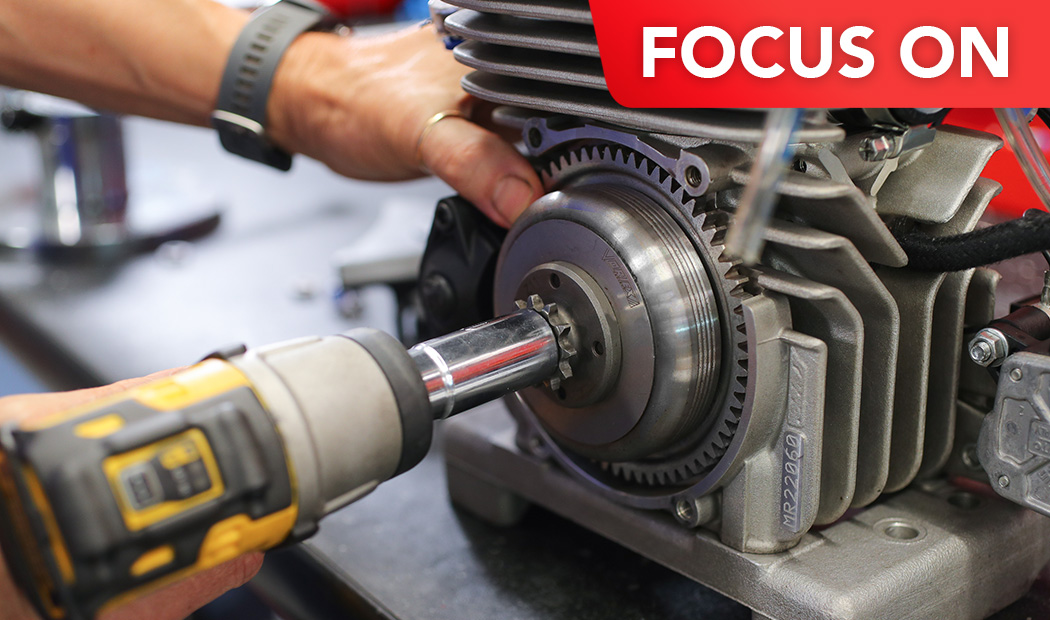
Here below are all the control and verification phases carried out on each individual engine, at the Vortex plant in Prevalle (BS).
Clutch check: washing and measuring
After washing, the clutch is checked. In particular, the internal diameter of the clutch housing and the external diameter of the friction masses are checked, in order to check that both are included in the dimensions set by the technical fiche. A clutch that does not respect the dimensions defined by Vortex can affect the performance of the engine itself on the track, especially in acceleration.
Check crankshaft clearance
With a special tool, check that the crankshaft has the right clearance (in the order of tenths of a millimeter). Also in this case, the verification operation aims to ensure the equality of performance between the various engines, since - for example - a crankshaft that does not rotate freely could impact performance.
Head disassembly
The head is disassembled and the dome is checked and cleaned of any deposits. Any thickening affects the volume and compression of the engine, elements that directly influence the performance of the engine itself. It is therefore checked that all the domes of the heads are perfectly adherent to the original design and a special template is used to verify this.
Check piston and rings dimensions
The interference between piston and cylinder is checked so that the tolerance is within the desired parameters. Added to this is the verification of the elastic band.
Cylinder reassembly
The cylinder is first visually inspected to verify that there are no marks of any kind on the cylinder liner. Subsequently, the cylinder liner is measured with a special instrument, to check for any ovalization and taper.
Squish and phase control
Once the head has been reassembled, proceed with the verification of the squish and the desired/pre-established spark advance.
Carburetor disassembly and cleaning
Deposits, debris and impurities in the carburetor can affect engine performance. For this reason, this component is disassembled, cleaned, overhauled, reassembled and set in an identical manner for all units.